Your Basket is Empty!
Wheel Alignment vs Wheel Balancing – What's the Difference?
Wheel Alignment vs Wheel Balancing – What's the Difference?
Many drivers use the terms wheel alignment and wheel balancing interchangeably, believing they are the same service. In reality, they are two completely different maintenance procedures, each playing a vital role in your vehicle's safety, performance and tyre lifespan.
If your steering wheel vibrates while driving, your vehicle pulls to one side, or your tyres are wearing unevenly, you may need either wheel alignment, wheel balancing, or in some cases, both.
Understanding the difference between these services can help you identify problems early, improve your driving experience and avoid costly tyre replacements.
In this guide, we'll explain what wheel alignment and wheel balancing are, how they differ, the signs you need each service and why regular maintenance is essential for keeping your vehicle safe on UK roads.
What Is Wheel Alignment?
Wheel alignment is the process of adjusting the angles of your vehicle's wheels so they match the manufacturer's specifications.
The goal is to ensure that all four wheels are positioned correctly relative to each other and the road surface. Proper alignment allows your tyres to make even contact with the road, improving handling, stability and tyre life.
Modern vehicles require extremely precise alignment settings, which is why professional garages use advanced systems such as Hunter Wheel Alignment to achieve accurate results.
What Does Wheel Alignment Adjust?
During a wheel alignment service, technicians check and adjust several important angles, including:
- Toe – The direction the tyres point when viewed from above.
- Camber – The inward or outward tilt of the wheels when viewed from the front.
- Caster – The angle of the steering pivot that affects straight-line stability and steering feel.
Correctly adjusting these angles ensures your vehicle drives straight, handles predictably and minimises unnecessary tyre wear.
Benefits of Wheel Alignment
Proper wheel alignment offers many advantages, including:
- Even tyre wear
- Improved steering accuracy
- Better handling
- Increased fuel efficiency
- Reduced strain on suspension components
- Longer tyre lifespan
- Improved driving comfort
- Greater vehicle stability
Regular alignment checks can save money by preventing premature tyre replacement.
Signs You Need Wheel Alignment
Your vehicle may require wheel alignment if you notice any of the following:
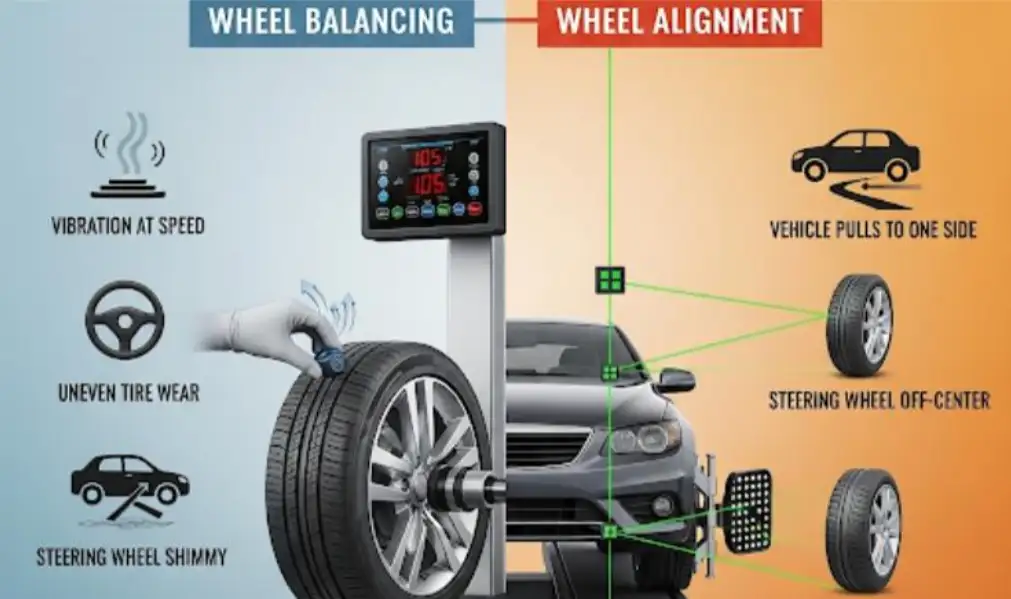
- The car pulls to the left or right.
- The steering wheel is off-centre when driving straight.
- Uneven tyre wear.
- Steering feels loose or unstable.
- Reduced fuel economy.
- You recently hit a pothole or kerb.
- Suspension components have been replaced.
Even a small alignment issue can significantly affect tyre life over time.
What Is Wheel Balancing?
Wheel balancing is the process of ensuring that the combined weight of the tyre and wheel assembly is evenly distributed around the axle.
Even brand-new tyres and alloy wheels have slight weight variations. During balancing, small adhesive or clip-on weights are fitted to the wheel to eliminate these imbalances.
Proper wheel balancing prevents vibration and ensures the wheels rotate smoothly at all speeds.
Why Is Wheel Balancing Important?
An unbalanced wheel rotates unevenly, causing vibration that becomes more noticeable as speed increases.
If left untreated, imbalance can lead to:
- Uneven tyre wear
- Steering wheel vibration
- Reduced ride comfort
- Increased suspension wear
- Premature tyre replacement
Wheel balancing is a simple yet highly effective way to improve driving comfort and tyre longevity.
Signs You Need Wheel Balancing
Common symptoms of wheel imbalance include:
- Steering wheel vibration, especially at motorway speeds
- Vehicle vibration through the seats or floor
- Uneven or patchy tyre wear
- Increased road noise
- Reduced driving comfort
- Recently fitted new tyres
Whenever new tyres are installed, wheel balancing should always be carried out.
Wheel Alignment vs Wheel Balancing
| Feature | Wheel Alignment | Wheel Balancing |
|---|---|---|
| Purpose | Adjusts wheel angles | Balances wheel weight |
| Main Benefit | Even tyre wear and improved handling | Eliminates vibration |
| Corrects | Steering and alignment issues | Weight imbalance in wheel assembly |
| Symptoms | Vehicle pulls to one side, uneven tyre wear | Steering wheel vibration at speed |
| Equipment Used | Hunter Wheel Alignment system | Electronic wheel balancing machine |
| Recommended After | Hitting potholes, suspension repairs, uneven tyre wear | Fitting new tyres, repairing punctures or if vibration develops |
Both services complement each other and are often performed together for the best results.
Do You Need Both Services?
In many cases, yes.
For example, if you have new tyres fitted, your garage will normally balance the wheels. If the old tyres showed signs of uneven wear, checking the wheel alignment at the same time is highly recommended.
Having both services completed together offers several benefits:
- Maximum tyre lifespan
- Better fuel economy
- Improved handling
- Smoother driving
- Increased safety
- Reduced maintenance costs
What Causes Wheel Alignment Problems?
Wheel alignment can gradually change over time due to everyday driving.
Common causes include:
- Potholes
- Kerb impacts
- Speed bumps
- Suspension wear
- Steering component replacement
- Accidents
- Heavy loads
Even minor impacts can affect alignment without the driver immediately noticing.
What Causes Wheels to Become Unbalanced?
Wheel imbalance can develop for several reasons, including:
- New tyre installation
- Tyre wear
- Missing balancing weights
- Impact damage
- Manufacturing tolerances
- Repairs to the tyre or wheel
Balancing ensures that these small weight differences do not affect driving performance.
How Often Should Wheel Alignment Be Checked?
Most experts recommend checking wheel alignment:
- Every 12 months
- After hitting a pothole or kerb
- When replacing suspension or steering components
- Whenever new tyres show uneven wear
- If the vehicle begins pulling to one side
Regular alignment checks are an inexpensive way to protect your tyres.
How Often Should Wheels Be Balanced?
Wheel balancing is recommended:
- Whenever new tyres are fitted
- After repairing a puncture
- If steering wheel vibration develops
- After replacing a wheel
- Whenever balancing weights are lost
There is no fixed mileage interval, but balancing should always be checked if vibration occurs.
Why Professional Equipment Matters
Modern vehicles require precise measurements that cannot be achieved using basic tools.
At Central Tyres Walsall, we use advanced Hunter Wheel Alignment technology to accurately measure and adjust your vehicle's wheel geometry according to manufacturer specifications.
Our professional wheel balancing equipment ensures every wheel rotates smoothly, improving comfort and extending tyre life.
By using industry-leading technology, we help customers achieve better performance, improved safety and longer-lasting tyres.
The Cost of Ignoring Alignment and Balancing Issues
Many drivers continue driving despite minor steering or vibration issues, assuming they are harmless.
Unfortunately, delaying repairs can result in:
- Rapid tyre wear
- Poor fuel economy
- Reduced braking performance
- Suspension damage
- Increased repair costs
- Lower driving comfort
- Reduced vehicle safety
Addressing these problems early helps prevent expensive repairs later.
Trust Central Tyres Walsall for Expert Wheel Alignment and Wheel Balancing
At Central Tyres Walsall, we provide professional Hunter Wheel Alignment and precision wheel balancing services for all makes and models. Whether your vehicle pulls to one side, your steering wheel vibrates or your tyres are wearing unevenly, our experienced technicians can quickly identify the cause and restore your vehicle's performance.
Using state-of-the-art diagnostic equipment, we ensure your wheels are correctly aligned and balanced to maximise tyre life, improve handling and deliver a smoother, safer driving experience. We also offer tyre replacement, wheel balancing, car servicing, brake repairs, battery replacement and a full range of vehicle maintenance services to keep your car in excellent condition.
Contact Central Tyres Walsall
Address
29 John Street
Walsall
WS2 8AF
United Kingdom
Phone
If you're experiencing steering problems, uneven tyre wear or vibration while driving, visit Central Tyres Walsall today. Our friendly team will inspect your vehicle, recommend the right solution and help keep your tyres performing at their best.
Recent Blogs